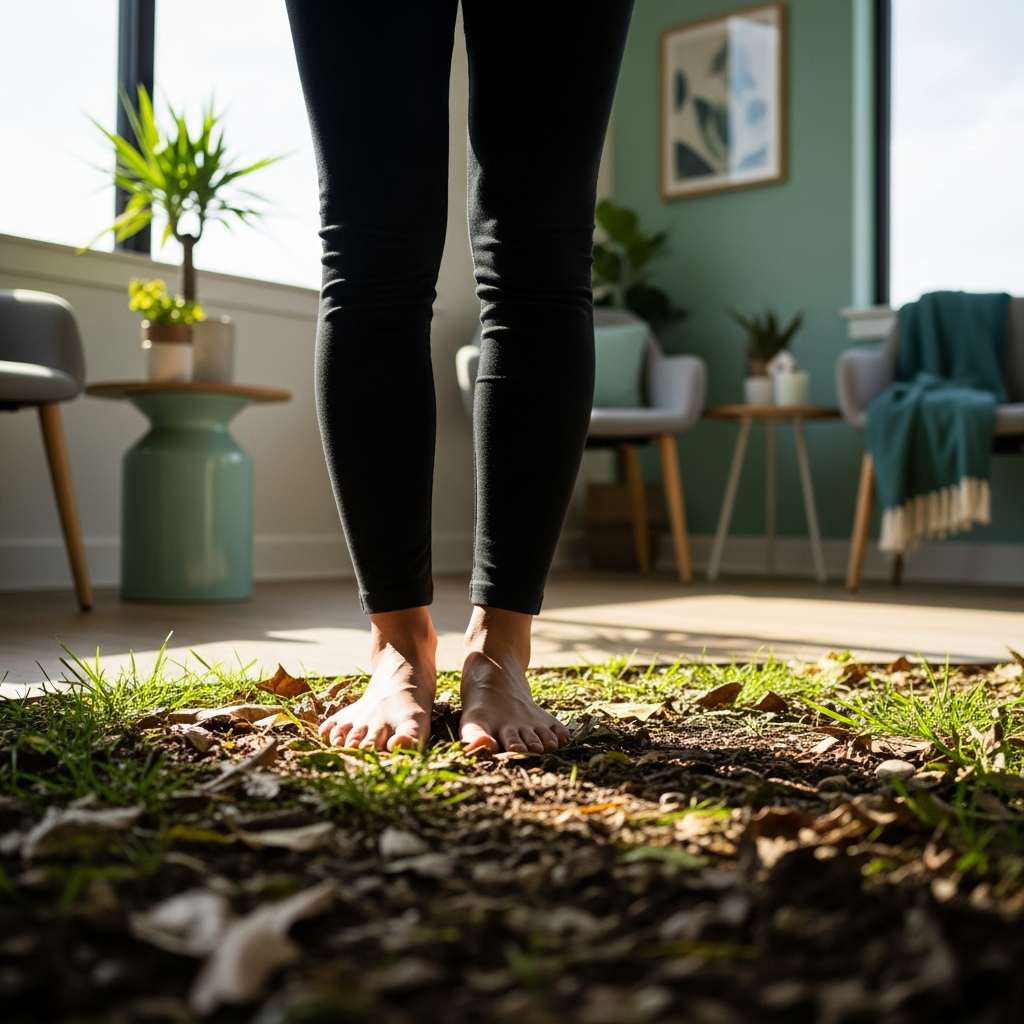
Have You Ever Really Considered Your Feet?
Not much, I hear you say — why would you? Probably because most of our attention lives in our upper body. We spend so much time in our heads, looking outwards, engaging with what's in front of us — phones, computers, driving cars, sitting on chairs and sofas. In all of that, our feet quietly get on with the job of holding us up.
And yet, your feet are your foundation. They're the first part of you that meets the ground, and they're constantly collecting information about the world beneath you — hard pavement, carpet, sand, grass, uneven woodland paths. That information doesn't just "stay" in your feet. It travels up through your nervous system and influences how the rest of you organises itself.
My Relationship with Feet (and the Ground)
In my youth I practised ballet and dance regularly, and later on in my late teens yoga took the forefront of my world. These disciplines broadened my movement vocabulary and helped me build a much better relationship with my feet.
Over the years, I naturally gravitated towards comfortable footwear, stayed away from heels, spent more time barefoot, and developed a steady relationship with the ground. Mindful walking drew my attention to different terrains — sand, mud, rock, grass, tree roots — and how my body subtly changes to meet each one. It's quite beautiful, actually, when you start to notice it: the micro-adjustments, the softness or grip through the toes, the way the ankles and hips respond.
Your Feet Are Sensory Organs, Not Just "Supports"
We often think of feet as purely structural — arches, heels, bones — but they're sensory too. The soles of your feet have thousands of nerve endings, and your body uses that sensory input to help with balance, coordination, and posture.
If your feet feel disconnected (from stiff footwear, lack of movement variety, or simply years of not paying attention), the body will still find a way to keep you upright — it just might do it with more tension.
That's where we start seeing patterns like:
- Gripping through the toes or holding the feet rigid
- Ankles that don't move freely
- Knees that collapse inwards or lock out
- Hips that hike up on one side
- A pelvis that tips forwards or backwards
- A low back that tightens to stabilise
- Shoulders and neck doing far more work than they should
Your body is always problem-solving. If one part isn't doing its share, something else will step in.
The "Chain Reaction" Up the Body
When you walk, your foot doesn't just land and lift. It rolls, loads, adapts, and pushes off. Ideally, the foot can absorb impact and then create a stable base for the rest of the leg. If that process is disrupted — through stiffness, weakness, pain, or poor mechanics — the knock-on effects often show up elsewhere.
A Few Common Examples We See:
1. Limited Ankle Movement
If the ankle can't bend well (especially into dorsiflexion — that forward movement as your knee travels over your toes), the body will compensate. You may turn the foot out, flatten the arch, overuse the calf, or shift movement into the knee and hip.
2. A Foot That Collapses or Grips
A foot that collapses can change how the shin rotates, which influences the knee. A foot that grips can keep everything "switched on" all the time — and constant tension can travel upwards.
3. Uneven Loading
If one foot bears more load than the other (even subtly), you may shift your pelvis, compress one side of the low back, or twist through the ribcage. Over time, that can become your "normal", and it can affect how you stand, walk, and breathe.
None of this is about perfection. It's about awareness — and giving your body more options.
Modern Life Doesn't Give the Feet Much Variety
Think about it: most of us walk on flat, predictable surfaces in supportive shoes. That isn't "bad", but it does mean your feet don't have to adapt very much. Over time, they can become less resilient, less mobile, and less responsive.
If we never ask the feet to do anything different, they may start to offload the work to other areas — often the calves, knees, hips, or lower back.
This is one reason why reintroducing gentle variety can feel so helpful. It's not about pushing through discomfort. It's about slowly waking things up.
Try This: Mindful Walking
Next time you're out and about, try becoming more mindful with your steps.
- Notice where you land — heel, midfoot, forefoot?
- Notice if your toes spread or grip.
- Notice if your weight sits more on the inside or outside of the foot.
- Notice what your knees and hips want to do as you step.
- Notice whether you lean forwards, sit back, or hold your breath.
You might be surprised how quickly you start to pick up patterns.
If you're curious, you could also experiment with footwear that makes your feet more active and engaged (less rigid, more flexible) — but take it slowly. If your feet have been "supported" for years, they may need time to build capacity again.
A Few Gentle Ways to Support Your Feet
You don't need a complicated routine. Small, consistent habits go a long way.
- Spend a little time barefoot at home (if it feels comfortable and safe)
- Try toe-spreading: gently separate the toes with your fingers, breathe, and relax
- Calf and sole massage: the feet and calves often hold a lot more than we realise
- Ankle circles and slow heel raises: controlled movement is nourishment
- Stand and feel the ground: soften the knees, breathe, let the weight drop evenly
The goal isn't to "fix" yourself. It's to reconnect.
Grounded, Yet Reaching
Being a yogi, I often remind myself that my feet are my root system, and the top of my head has a crown reaching for the stars. Be grounded, yet stand tall.
When your feet feel supported — not just by shoes, but by awareness and circulation and movement — the rest of you often follows. Your posture becomes less forced. Your gait becomes more fluid. You may even find your upper body doesn't have to work quite so hard.
If Your Feet Could Do With a Little More Care
If your feet feel tired, tight, achy, or simply "neglected", a focused treatment can be a lovely reset — not just for the feet themselves, but for your whole system.
We offer deep tissue foot treatments and reflexology with me at b2 clinic. If you'd like to explore what your feet might be asking for, we're here.
Treat your feet. They've been carrying you all along.
About Alexandra Williams
Alexandra Williams is a practitioner at b2 Chalfont Clinic with extensive experience helping patients achieve optimal health through evidence-based care.
View Full ProfileReady to Start Your Health Journey?
Book a free 10-minute consultation to discuss your concerns
Book Your Consultation